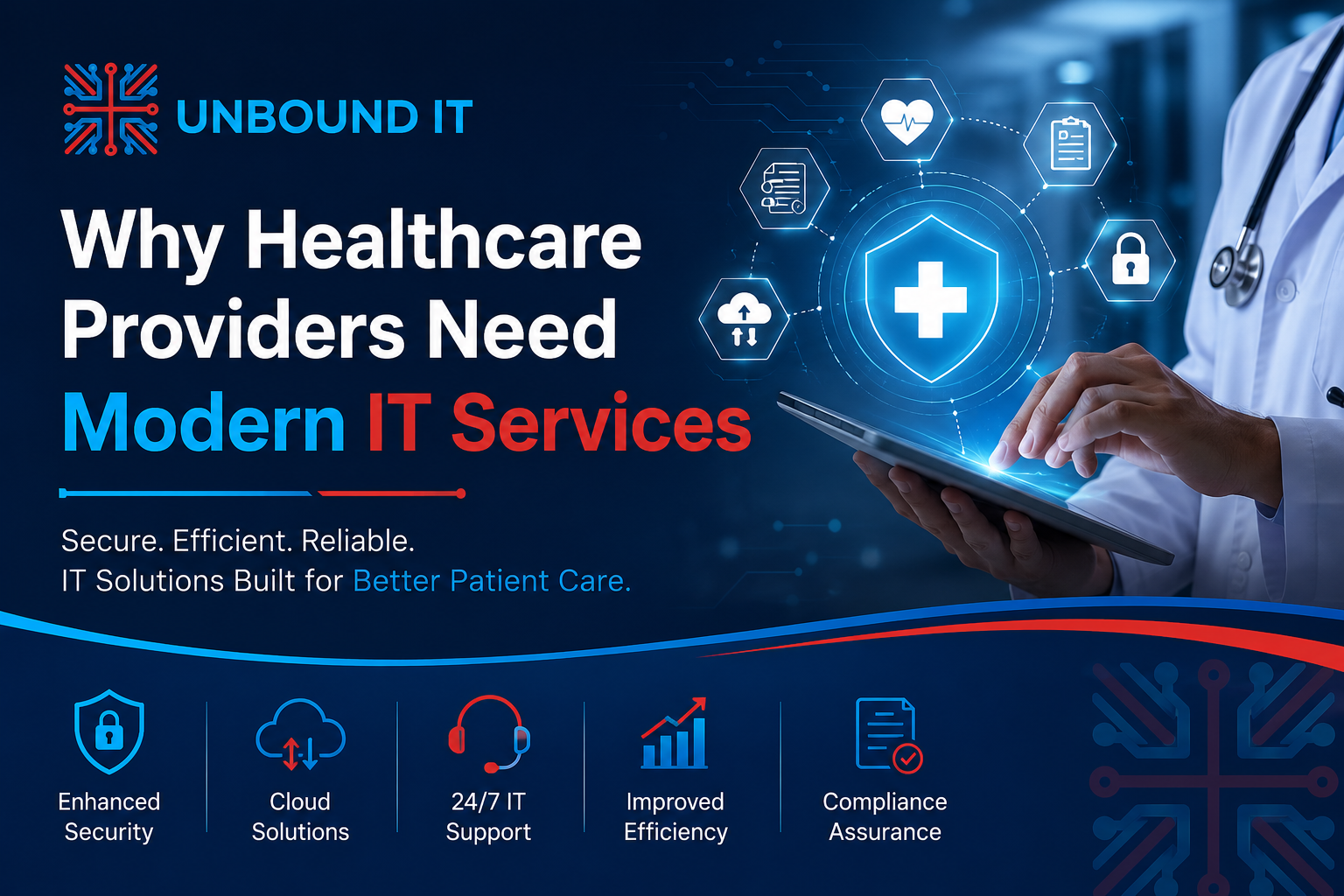

Unbound IT provides secure and modern IT services for healthcare, helping healthcare providers improve cybersecurity, compliance, cloud infrastructure, and patient care with reliable technology solutions.
Many healthcare organizations still rely on outdated systems that slow down daily operations, create security risks, and make it difficult to deliver quality patient care. This is why investing in IT services for healthcare is no longer an option. It is a necessity for organizations that want to improve efficiency, protect patient information, and stay compliant with industry regulations.
At Unbound IT, we help healthcare organizations build secure, reliable, and scalable IT environments that support better patient experiences and long-term business growth.
The Growing Importance of IT Services in Healthcare
Healthcare professionals are expected to provide excellent patient care while managing increasing workloads and strict regulatory requirements. At the same time, cyber threats continue to rise, patients expect faster services, and medical technologies continue to evolve.
Modern healthcare IT services help healthcare providers overcome these challenges by improving communication, automating repetitive tasks, securing sensitive information, and reducing downtime.
Technology is no longer limited to computers and networks. Today, it supports patient records, medical imaging, laboratory systems, telehealth platforms, cloud storage, connected medical devices, billing systems, and communication between departments.
Healthcare providers that invest in modern IT infrastructure can spend more time focusing on patients instead of dealing with technical issues.
Why Traditional IT Systems No Longer Work
Many healthcare organizations still operate with old servers, outdated software, and unsupported hardware. These systems may appear to save money, but they often create larger problems.
Older systems are slower, more vulnerable to cyberattacks, and difficult to maintain. They may also fail to integrate with modern healthcare applications.
The result is frequent downtime, frustrated staff, delayed patient care, and increased operational costs.
The comparison below shows the difference between traditional systems and modern healthcare IT.
| Traditional IT Systems | Modern Healthcare IT Services |
|---|---|
| Slow system performance | Fast and reliable infrastructure |
| Manual record management | Digital patient records |
| Limited security | Advanced cybersecurity protection |
| Difficult software updates | Automatic updates and monitoring |
| High downtime | Proactive maintenance |
| Poor scalability | Easy expansion as the organization grows |
| Separate systems | Integrated healthcare platforms |
Healthcare providers that modernize their technology gain better reliability while improving patient satisfaction.
Better Patient Care Starts with Better Technology
Patients expect quick appointments, secure communication, accurate records, and faster treatment. Technology helps healthcare professionals deliver all of these services more efficiently.
Doctors can access medical histories instantly. Nurses can update patient records in real time. Administrative staff can schedule appointments without delays. Lab reports become available faster, allowing doctors to make informed treatment decisions.
Modern IT solutions for healthcare reduce administrative burdens so healthcare professionals can focus on patient care.
This improves both clinical outcomes and patient satisfaction.
Protecting Sensitive Patient Information
Healthcare organizations store some of the most valuable personal information. Medical records contain names, addresses, insurance details, medical histories, prescriptions, and financial information.
Cybercriminals actively target healthcare organizations because this data has significant value.
Without proper security, healthcare providers face risks such as ransomware attacks, phishing attempts, data breaches, and unauthorized access.
Modern healthcare IT solutions include multiple layers of protection.
These services typically include encrypted data storage, multi-factor authentication, endpoint security, firewall protection, email security, regular security updates, vulnerability assessments, backup systems, and disaster recovery planning.
A secure IT environment protects patients while helping organizations maintain trust and avoid costly disruptions.
Supporting Regulatory Compliance
Healthcare organizations must comply with industry regulations that govern how patient information is stored, accessed, and shared.
Compliance requires secure systems, controlled access, audit logs, backup procedures, and documented security policies.
Without proper IT management, maintaining compliance becomes difficult and increases the risk of penalties.
Professional healthcare IT support helps organizations implement secure systems that meet regulatory requirements while simplifying ongoing compliance management.
IT specialists continuously monitor systems, identify security risks, and ensure that software remains updated.
Reducing Downtime Across Healthcare Facilities
Every minute of downtime affects patient care.
If doctors cannot access patient records or laboratory systems become unavailable, treatment decisions may be delayed. Appointment scheduling may stop, communication may fail, and administrative work quickly falls behind.
Modern IT services focus on preventing problems before they happen.
Continuous monitoring identifies issues early. Preventive maintenance reduces hardware failures. Automated backups protect important data. Redundant systems ensure that critical applications remain available even during unexpected incidents.
Healthcare providers experience fewer interruptions and more reliable daily operations.
Supporting Telehealth and Remote Care
Telehealth has become an important part of healthcare delivery.
Patients appreciate the convenience of virtual consultations, especially for follow-up appointments and routine medical advice.
Healthcare organizations need secure video platforms, reliable internet connectivity, cloud-based applications, and protected communication channels.
Modern IT services for healthcare provide the infrastructure required to support secure telemedicine services without compromising patient privacy.
Healthcare providers can expand access to care while maintaining high standards of security.
Cloud Technology Makes Healthcare More Flexible
Cloud computing has transformed healthcare operations.
Instead of depending entirely on local servers, healthcare organizations can securely access applications and patient information from authorized locations.
Cloud technology offers several operational advantages.
Healthcare teams can work from multiple locations, disaster recovery becomes faster, software updates become easier, and storage capacity can grow as needed.
Cloud systems also improve collaboration between departments, making patient information available whenever it is required.
Organizations that adopt cloud technology often experience lower infrastructure costs while improving system reliability.
Faster Access to Medical Records
Electronic Health Records have replaced paper files in many healthcare organizations.
Modern healthcare systems allow doctors to review medical histories, prescriptions, allergies, diagnostic reports, and treatment plans within seconds.
This reduces paperwork and minimizes the risk of missing important patient information.
Accurate digital records also improve communication between specialists, laboratories, pharmacies, and administrative teams.
The result is better coordinated patient care.
Managed IT Services Improve Operational Efficiency
Many healthcare organizations do not have large internal IT departments.
Hiring multiple specialists can be expensive and difficult, especially for smaller clinics.
This is where managed IT services for healthcare provide significant value.
Instead of reacting after problems occur, managed service providers continuously monitor systems, perform maintenance, install updates, improve cybersecurity, and provide technical support whenever needed.
Healthcare staff can focus on treating patients instead of solving technology problems.
The comparison below highlights the difference.
| Break-Fix IT Support | Managed IT Services for Healthcare |
|---|---|
| Problems fixed after failure | Problems prevented before failure |
| Unpredictable expenses | Predictable monthly costs |
| Limited monitoring | Continuous monitoring |
| Reactive support | Proactive support |
| Longer downtime | Faster issue resolution |
| Minimal planning | Long-term IT strategy |
This proactive approach improves reliability while reducing unexpected costs.
Improving Communication Between Departments
Healthcare depends on collaboration.
Doctors, nurses, specialists, pharmacists, laboratories, billing teams, and administrators all need accurate information at the right time.
Modern healthcare technology connects departments through integrated systems.
Patient information updates instantly, reducing communication delays and minimizing duplicate work.
Staff spend less time searching for information and more time delivering quality care.
Scalability for Future Growth
Healthcare organizations continue to grow by opening new locations, adding staff, expanding services, or introducing new technologies.
An outdated IT infrastructure often struggles to support growth.
Modern healthcare IT services are designed to scale.
Organizations can add users, expand storage, integrate new software, and connect additional locations without replacing their entire technology environment.
Scalable systems reduce future costs while supporting long-term business growth.
Data Backup and Disaster Recovery
Unexpected events such as cyberattacks, hardware failures, natural disasters, or accidental deletion can lead to data loss.
Without proper backups, healthcare organizations risk losing valuable patient information.
Modern IT services automatically back up important data and create disaster recovery plans.
If systems fail, organizations can quickly restore operations with minimal disruption.
Reliable backups provide peace of mind while protecting patient care.
Supporting Connected Medical Devices
Many hospitals now use connected medical equipment.
Patient monitors, imaging systems, laboratory equipment, and smart medical devices all depend on reliable network infrastructure.
Poor network performance affects device communication and may delay patient care.
Professional IT support for healthcare ensures that connected devices remain secure, reliable, and fully operational.
IT specialists monitor network performance while maintaining compatibility between devices and healthcare software.
Lower Long-Term Costs
Many organizations assume that upgrading technology is expensive.
In reality, outdated systems often cost more over time.
Old hardware requires frequent repairs. Downtime reduces productivity. Security incidents create unexpected expenses. Manual processes increase administrative costs.
Modern IT investments reduce these hidden costs.
Automation improves efficiency, proactive maintenance prevents expensive failures, and better cybersecurity reduces financial risks associated with data breaches.
Healthcare organizations achieve better financial performance while improving patient care.
Better Experience for Healthcare Staff
Technology should make work easier, not harder.
Doctors and nurses already work under significant pressure.
Slow computers, unreliable software, and frequent technical issues increase frustration and reduce productivity.
Modern systems provide faster access to information, simpler workflows, reliable communication, and fewer technical interruptions.
Satisfied employees often provide better patient experiences.
Choosing the Right Healthcare IT Partner
Not every IT provider understands the unique requirements of healthcare.
Healthcare organizations need an IT partner with experience in security, compliance, cloud technology, infrastructure management, disaster recovery, and ongoing technical support.
A reliable IT partner should understand healthcare workflows and provide solutions that improve patient care rather than creating unnecessary complexity.
At Unbound IT, we work closely with healthcare providers to develop secure, scalable, and reliable technology solutions that meet current operational needs while preparing organizations for future growth.
Our team focuses on improving infrastructure, strengthening cybersecurity, supporting cloud migration, monitoring systems around the clock, and providing responsive technical support whenever it is needed.
The Future of Healthcare Depends on Modern Technology
Healthcare technology will continue to evolve.
Artificial intelligence, predictive analytics, automation, wearable health devices, remote monitoring, and cloud-based platforms are already changing how healthcare services are delivered.
Organizations that invest in modern technology today will be better prepared for future innovations.
Modern IT infrastructure provides the foundation needed to adopt new healthcare technologies without disrupting daily operations.
Healthcare providers that delay modernization may struggle to remain competitive as patient expectations continue to increase.
Conclusion
Technology has become an essential part of delivering safe, efficient, and high-quality healthcare. Modern IT services for healthcare help organizations improve patient care, strengthen cybersecurity, reduce downtime, simplify compliance, and support future growth.
Whether managing a small medical practice or a large healthcare network, investing in reliable technology creates long-term benefits for patients, healthcare professionals, and administrators alike.
Partnering with an experienced provider like Unbound IT allows healthcare organizations to focus on what matters most, delivering exceptional patient care while leaving technology management to experts. With the right strategy and ongoing support, healthcare providers can build a secure, efficient, and future-ready IT environment that supports success for years to come.