
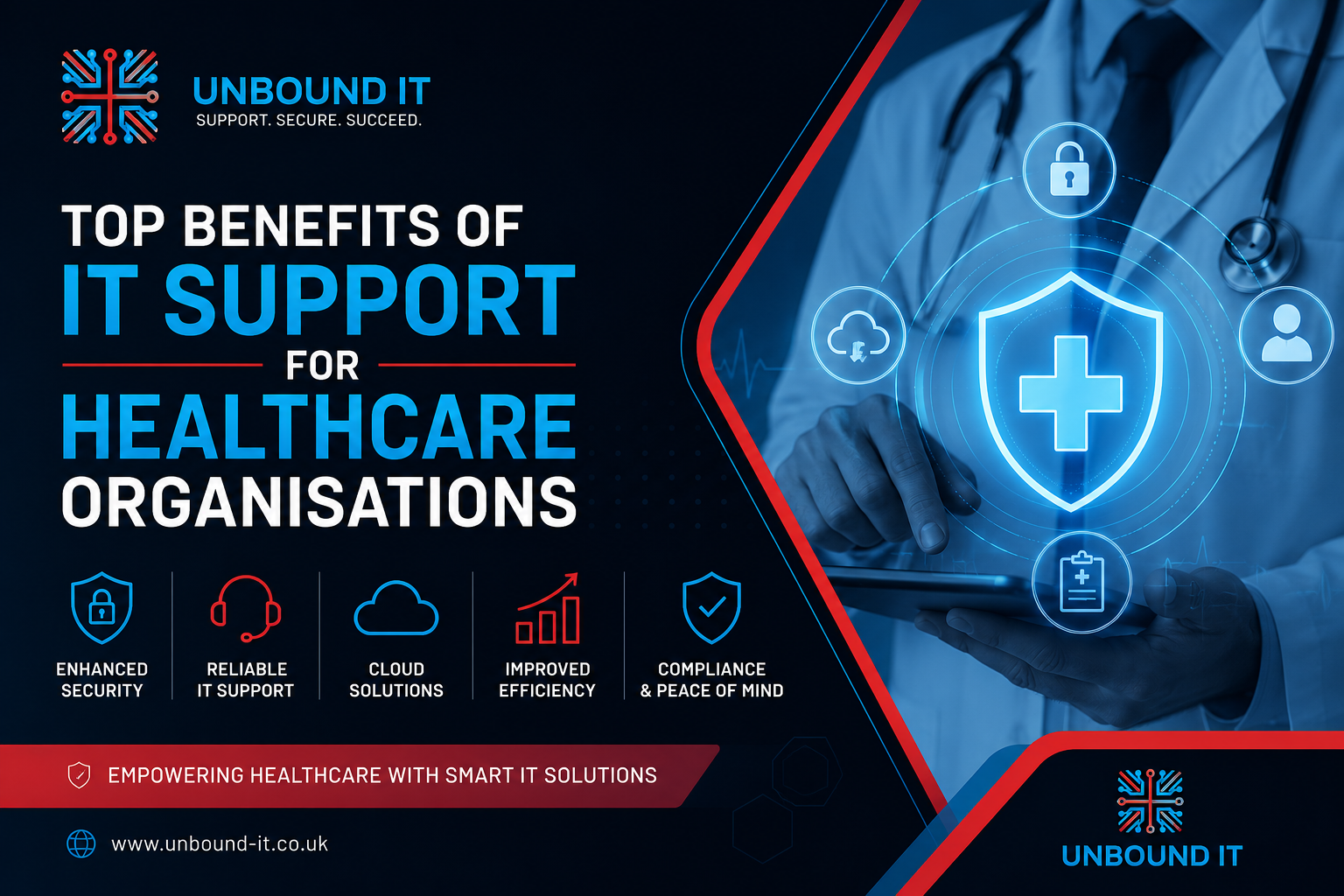

UNBOUND-IT | Top Benefits of IT Support for Healthcare Organisations
Healthcare organisations rely on technology every day. Patient records, appointment systems, emails, billing software, and communication tools all depend on reliable IT systems. If any of these systems stop working, it can affect staff, patients, and daily operations.
Many healthcare providers still think about IT only when something goes wrong. A server fails, computers become slow, or a cyber attack locks important files. By that point, the damage has already been done. Lost time, cancelled appointments, and security risks can quickly become expensive problems.
Professional IT support helps prevent these issues before they affect the organisation. Instead of waiting for problems to happen, experienced IT teams monitor systems, apply updates, improve security, and keep everything running as expected.
Whether you manage a GP practice, dental surgery, private clinic, pharmacy, care home, or specialist healthcare facility, reliable IT support helps your organisation deliver better patient care while keeping important information secure.
Why Technology Has Become Essential in Healthcare
Healthcare has changed significantly over the last decade. Most organisations now use digital systems instead of paper records. Doctors and nurses need instant access to patient information, reception teams rely on appointment software, and managers use cloud platforms to organise daily work.
Patients also expect faster services. Many people now book appointments online, receive digital reminders, and communicate through secure online systems. These services only work when the technology behind them is reliable.
When IT systems perform well, staff can focus on patients instead of technical problems. This improves productivity across the organisation and creates a better experience for everyone.
Technology is no longer something that supports healthcare. It has become part of healthcare itself.
The Challenges Healthcare Organisations Face
Running healthcare technology is not always straightforward. Every organisation depends on different software, devices, and networks. As these systems become more connected, managing them also becomes more difficult.
Cybersecurity is one of the biggest concerns. Healthcare organisations store confidential patient information, making them a common target for cyber criminals. A single phishing email or ransomware attack can interrupt services and place sensitive information at risk.
Downtime is another common challenge. If appointment systems stop working or staff cannot access patient records, healthcare professionals lose valuable time. Even short periods of disruption can affect patient care and reduce productivity.
Many organisations also continue using older hardware because replacing equipment requires investment. Older systems often run more slowly, receive fewer security updates, and are more likely to fail when they are needed most.
At the same time, healthcare providers must meet legal responsibilities for protecting patient information. Managing compliance while also running day-to-day operations can place additional pressure on internal teams.
These challenges explain why many organisations now choose managed IT support instead of relying on reactive repairs.
What Is IT Support for Healthcare?
IT support for healthcare is a service that helps healthcare organisations manage, maintain, and protect their technology. The goal is to keep systems available, secure, and performing efficiently so healthcare professionals can concentrate on patient care.
A managed IT provider looks after servers, computers, networks, cloud services, cybersecurity, software updates, backups, and user support. Rather than waiting for something to break, they work to prevent problems through regular maintenance and continuous monitoring.
This approach reduces downtime and gives organisations access to experienced engineers without employing a large in-house IT department.
The table below shows the difference between reactive IT support and managed IT support.
| Reactive IT Support | Managed IT Support |
|---|---|
| Problems are fixed after they happen | Problems are identified before they cause disruption |
| Emergency repair costs vary each month | Predictable monthly support costs |
| Limited monitoring | Continuous system monitoring |
| Software updates may be delayed | Updates are managed regularly |
| Higher risk of downtime | Better system reliability |
For healthcare organisations, preventing problems is often more valuable than fixing them after they occur.
Why Healthcare Organisations Are Choosing Managed IT Services
Healthcare providers are under constant pressure to improve services while controlling costs. Patients expect reliable care, staff need dependable technology, and regulations continue to become more demanding.
Managed IT services help organisations meet these expectations by providing specialist support whenever it is needed. Instead of depending on one internal employee to manage every technical issue, organisations gain access to a team with experience across cybersecurity, networking, cloud platforms, Microsoft 365, backups, and business continuity.
This approach also makes financial planning easier. Monthly support agreements reduce unexpected repair costs and help organisations budget more effectively.
Small clinics and growing healthcare providers often benefit the most because they receive enterprise-level IT support without employing a full internal department.
As technology continues to develop, reliable IT support is becoming an important part of delivering safe, efficient, and secure healthcare services.
How IT Support Improves Patient Care
The quality of patient care depends on many factors, and technology is now one of them. Doctors, nurses, and administrative staff need quick access to patient records, appointment schedules, test results, and communication systems throughout the day. When these systems work properly, patients receive faster and more organised care.
If technology becomes slow or unavailable, staff spend more time dealing with technical issues instead of helping patients. Appointments may be delayed, records may take longer to access, and communication between departments can become difficult. These small problems can quickly affect the overall patient experience.
Professional IT support helps prevent these situations. Systems are monitored throughout the day, updates are installed regularly, and problems are resolved before they interrupt normal operations. This allows healthcare professionals to concentrate on clinical work instead of technical issues.
Healthcare organisations that invest in reliable IT support often see improvements in efficiency, communication, and patient satisfaction because staff have dependable technology available whenever they need it.
Protecting Patient Data
Healthcare organisations manage large amounts of confidential information every day. Medical records, contact details, prescriptions, and financial information must all be stored securely.
Cyber criminals know that healthcare data is valuable. This makes hospitals, clinics, GP surgeries, dental practices, and care homes common targets for ransomware and phishing attacks.
Professional IT support reduces these risks by keeping systems secure. Security updates are applied regularly, suspicious activity is monitored, and access to sensitive information is controlled carefully. Multi-factor authentication, encrypted backups, and secure email protection all help reduce the chance of unauthorised access.
Protecting patient information is not only about avoiding cyber attacks. It also helps maintain patient trust and supports compliance with UK data protection regulations.
Reducing Downtime
Every healthcare organisation experiences technical problems from time to time. The difference is how quickly those problems are identified and resolved.
When systems fail unexpectedly, appointments may need to be rearranged and staff may lose access to important information. This affects productivity and creates unnecessary pressure during busy working days.
Managed IT support focuses on preventing these situations. Engineers monitor networks, servers, and computers throughout the day. Small issues are often fixed before staff even notice there is a problem.
This proactive approach helps reduce disruption and keeps healthcare services operating more smoothly.
The difference between reactive and proactive support is shown below.
| Reactive Support | Proactive Support |
|---|---|
| Problems are fixed after failure | Problems are identified before failure |
| Higher risk of downtime | Better system availability |
| Emergency repairs | Planned maintenance |
| Slower response | Continuous monitoring |
| Greater disruption | Improved reliability |
Healthcare organisations depend on reliable systems every day. Preventing downtime is often more valuable than recovering from it.
Better Data Backup and Recovery
Data loss can happen for many reasons. Hardware failures, accidental deletion, software problems, cyber attacks, and power outages all have the potential to interrupt healthcare services.
Without reliable backups, recovering important patient information may take days or may not be possible at all.
Professional IT support includes automatic backups that are tested regularly. If a problem occurs, data can be restored quickly, reducing disruption to the organisation.
Backup planning is also part of a wider disaster recovery strategy. This ensures healthcare providers can continue operating even after unexpected incidents.
Reliable backups provide confidence that important information remains protected regardless of what happens.
Improving Staff Productivity
Healthcare professionals should spend their time caring for patients rather than dealing with slow computers or software problems.
Reliable IT systems improve the speed of everyday tasks. Staff can access patient information quickly, communicate more effectively, and complete administrative work without unnecessary delays.
Technical support also reduces frustration among employees. Instead of waiting hours for problems to be resolved, they receive assistance from experienced engineers who understand healthcare systems.
Moving Healthcare Systems to the Cloud
Cloud technology has changed the way healthcare organisations work. Instead of relying entirely on local servers, organisations can store information securely in cloud platforms that are available from approved locations.
This gives staff greater flexibility without reducing security. Doctors working across multiple sites can access patient information more easily, while managers can collaborate using cloud-based applications.
Cloud services also reduce the need for expensive hardware upgrades. Storage can be increased when required, software updates happen automatically, and data is backed up more efficiently.
The comparison below explains the difference.
| Traditional IT Infrastructure | Cloud-Based IT |
|---|---|
| Higher hardware costs | Lower infrastructure costs |
| Limited remote access | Secure remote access |
| Manual software updates | Automatic updates |
| Local backups | Cloud backups |
| Difficult to expand | Easy to scale |
Cloud technology allows healthcare organisations to grow without replacing their entire IT infrastructure.
Meeting GDPR and Healthcare Security Requirements
Healthcare organisations have a legal responsibility to protect patient information.
The UK General Data Protection Regulation requires organisations to manage personal information responsibly and securely. Healthcare providers also need appropriate security controls to reduce the risk of data breaches.
Professional IT support helps organisations meet these responsibilities by managing software updates, monitoring network activity, controlling user access, and maintaining secure backups.
Compliance should not be viewed as a one-time task. Technology changes continuously, and new security risks appear every year. Ongoing monitoring helps organisations remain compliant while reducing operational risk.
Managed IT Support or In-House IT?
Many healthcare organisations ask whether they should build an internal IT department or outsource support to a managed service provider.
The answer often depends on budget, available expertise, and long-term business goals.
Smaller organisations usually benefit from managed IT because they gain access to experienced specialists without employing multiple technical staff.
Larger organisations may still have an internal IT team while outsourcing specialist services such as cybersecurity, cloud management, and disaster recovery.
The comparison below explains the differences.
| In-House IT Team | Managed IT Support |
|---|---|
| Recruitment costs | Fixed monthly cost |
| Limited internal expertise | Access to experienced specialists |
| Staff holidays affect support | Ongoing service throughout the year |
| Additional training required | Skills already available |
| Difficult to scale | Easy to scale as the organisation grows |
Many healthcare providers now combine internal staff with managed IT support to achieve the best balance between cost and technical expertise.
Choosing the Right IT Support Provider
Selecting the right IT provider is an important decision. Healthcare organisations need more than someone who fixes computers when they stop working.
A good IT partner understands the healthcare sector, provides fast technical support, monitors systems continuously, and takes cybersecurity seriously.
It is also important to choose a provider that offers clear communication and predictable pricing. Organisations should know exactly what services are included and how quickly support will be available when issues arise.
Experience with cloud services, Microsoft 365, cybersecurity, backup planning, and network management is also valuable because these areas are becoming increasingly important across the healthcare sector.
The right IT provider becomes part of the organisation rather than simply an external contractor.
Conclusion
Technology has become an essential part of modern healthcare. From managing patient records and appointment systems to protecting sensitive information, reliable IT systems help healthcare organisations provide safe and efficient services every day.
Professional IT support does more than fix technical problems. It helps prevent downtime, improves cybersecurity, protects patient data, and keeps systems running smoothly. It also allows healthcare professionals to spend more time with patients instead of dealing with IT issues.
Whether you manage a GP practice, dental surgery, private clinic, pharmacy, or care home, investing in reliable IT support can improve daily operations and prepare your organisation for future growth. As healthcare technology continues to evolve, having the right IT partner can make a real difference to both staff and patient experience.
At UNBOUND-IT, we provide managed IT support that is tailored to the needs of healthcare organisations across the UK. Our team works to keep your systems secure, reliable, and up to date, so you can focus on delivering the highest standard of care.
If you are looking for trusted IT support for healthcare or want to learn how managed IT services can benefit your organisation, contact UNBOUND-IT today. We are ready to help you build a secure, reliable, and future-ready IT environment.
Frequently Asked Questions
What is IT support for healthcare?
IT support for healthcare includes technology services that help healthcare organisations manage their networks, computers, cloud systems, cybersecurity, patient data, software, and technical infrastructure.
Why is cybersecurity important in healthcare?
Healthcare organisations store sensitive patient information, making them attractive targets for cybercriminals. Strong cybersecurity protects confidential data, reduces downtime, and helps organisations meet regulatory requirements.
What are managed IT services for healthcare?
Managed IT services provide ongoing monitoring, maintenance, cybersecurity, technical support, software updates, backups, and strategic IT planning for healthcare organisations under a fixed monthly service agreement.
How can healthcare IT services improve patient care?
Reliable IT systems allow healthcare professionals to access patient records quickly, reduce appointment delays, improve communication, and minimise technology-related disruptions, leading to better patient outcomes.
Why should healthcare organisations choose UNBOUND-IT?
UNBOUND-IT delivers proactive IT support, cybersecurity, cloud services, and tailored technology solutions that help healthcare organisations across the UK improve security, efficiency, compliance, and overall performance.