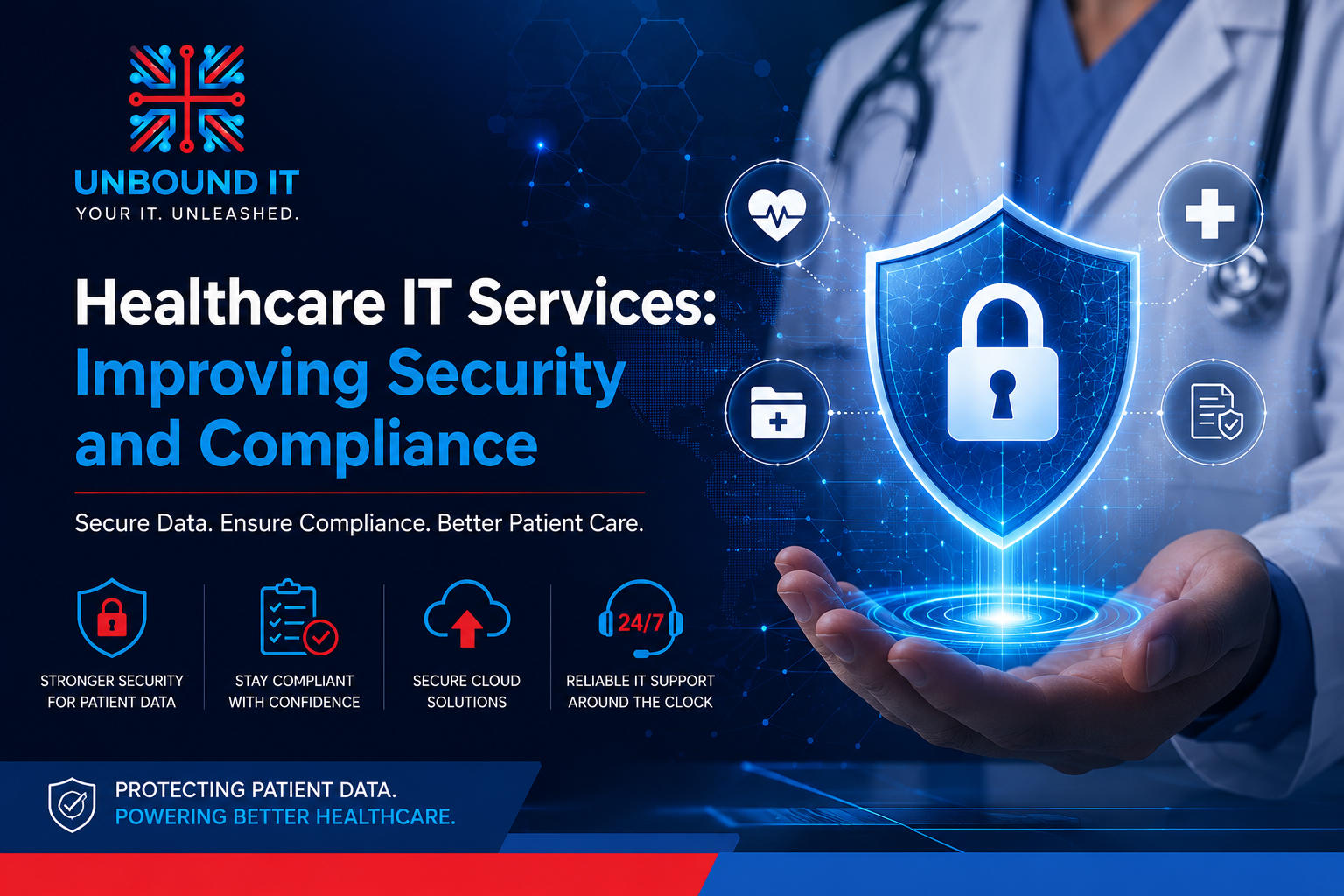

Healthcare IT services by UNBOUND IT to improve security, compliance, and patient data protection.
Healthcare organizations handle some of the most sensitive information in the world. Every patient record contains personal details, medical history, prescriptions, insurance information, and payment data. Keeping this information secure is no longer just a technical responsibility. It is a business priority and a legal requirement.
As healthcare providers continue to adopt digital technologies, they also face growing cybersecurity risks. Ransomware attacks, phishing emails, data breaches, and system failures can interrupt patient care and damage trust. At the same time, healthcare organizations must meet strict compliance requirements while ensuring that doctors, nurses, and staff have reliable access to the systems they use every day.
This is where healthcare IT services play an important role. Professional IT support helps healthcare providers improve security, maintain compliance, reduce downtime, and deliver better patient care. Instead of reacting to problems after they occur, healthcare organizations can build a secure and reliable technology environment that supports long-term growth.
At UNBOUND-IT, we help healthcare organizations strengthen their IT infrastructure through secure, reliable, and scalable technology solutions designed for the healthcare sector.
Why Healthcare IT Services Matter More Than Ever
The healthcare industry has changed significantly over the last decade. Most patient records are now stored digitally, appointments are managed online, and many consultations happen through virtual platforms. Medical devices are connected to networks, and healthcare professionals rely on cloud-based applications every day.
While these changes improve efficiency and patient experience, they also increase security risks. Every connected device and every online system creates another point that cybercriminals may try to exploit.
Healthcare organizations also cannot afford long periods of downtime. If clinical systems become unavailable, appointments may be delayed, treatments interrupted, and patient care affected.
Professional healthcare IT services help reduce these risks by monitoring systems, identifying vulnerabilities, and maintaining secure technology environments around the clock.
Common IT Challenges Healthcare Providers Face
Healthcare organizations face many technology challenges regardless of their size. Small clinics often have limited IT resources, while larger hospitals manage complex infrastructures with thousands of users and devices.
One common challenge is protecting patient information from cyber threats. Healthcare data is valuable because it contains personal and financial information that criminals can misuse.
Another challenge is keeping software updated. Many healthcare organizations still rely on older applications that may contain security vulnerabilities. Delayed software updates increase the risk of cyberattacks.
Healthcare providers also struggle with managing multiple systems. Electronic health records, appointment software, billing systems, communication platforms, and medical devices must all work together without interruptions.
Remote work has introduced additional challenges. Administrative staff, consultants, and healthcare professionals often need secure remote access to systems without exposing sensitive information.
Reliable IT support for healthcare helps organizations address these challenges before they affect patient services.
Protecting Patient Data Through Strong Cybersecurity
Cybersecurity is one of the most important parts of modern healthcare technology.
Healthcare organizations store confidential patient information that must remain protected at all times. A single cyberattack can result in financial losses, legal penalties, operational disruption, and loss of patient trust.
Professional IT solutions for healthcare include multiple layers of protection that work together to reduce security risks.
Strong network security prevents unauthorized users from accessing internal systems. Advanced firewalls monitor incoming and outgoing traffic to block suspicious activity.
Endpoint protection secures laptops, desktops, tablets, and mobile devices used by healthcare staff. Since employees often access patient information from different locations, every device must remain protected.
Email security reduces the risk of phishing attacks, which remain one of the most common causes of healthcare data breaches.
Multi-factor authentication adds another layer of protection by requiring users to verify their identity before accessing sensitive systems.
Regular vulnerability assessments help identify weaknesses before cybercriminals can exploit them.
Instead of relying on a single security tool, modern healthcare organizations need a complete cybersecurity strategy supported by experienced IT professionals.
Understanding Healthcare Compliance
Security and compliance work together, but they are not the same.
Security focuses on protecting systems and data from threats. Compliance ensures that healthcare organizations follow industry regulations and legal requirements.
Healthcare providers must demonstrate that patient information is collected, stored, shared, and protected according to applicable regulations.
This requires proper access controls, encryption, audit logs, password policies, employee training, backup procedures, and documented security practices.
Without proper compliance management, organizations may face financial penalties, legal issues, and reputational damage.
Experienced providers of managed IT services for healthcare help organizations maintain compliant IT environments through continuous monitoring, documentation, regular assessments, and proactive maintenance.
Healthcare IT Services vs Traditional IT Support
Many organizations assume that general IT support is enough for healthcare environments. However, healthcare has unique security, compliance, and operational requirements that demand specialized expertise.
| Feature | General IT Support | Healthcare IT Services |
|---|---|---|
| Focus | Business technology | Patient care and secure healthcare operations |
| Compliance Knowledge | Limited | Healthcare compliance expertise |
| Data Protection | Standard security | Advanced patient data security |
| Monitoring | Business hours in many cases | Continuous monitoring and proactive support |
| Risk Management | General cybersecurity | Healthcare-specific risk management |
| Backup Strategy | Standard backups | Secure, tested recovery plans for critical healthcare data |
Healthcare organizations benefit from technology partners who understand clinical workflows, patient privacy requirements, and the importance of maintaining uninterrupted access to healthcare systems.
The Role of Managed IT Services in Healthcare
Many healthcare providers no longer rely on internal IT teams alone. Instead, they choose managed IT services for healthcare to gain access to experienced professionals, advanced security tools, and continuous monitoring.
Managed services provide proactive support rather than waiting for problems to occur.
Systems are monitored throughout the day to identify unusual activity before it becomes a serious issue.
Software updates are installed regularly to reduce security vulnerabilities.
Backups are monitored to ensure patient information can be recovered quickly if necessary.
Security patches are applied promptly to protect against newly discovered threats.
Healthcare organizations also receive strategic IT planning that helps them prepare for future technology needs while controlling costs.
This proactive approach reduces downtime, improves productivity, and allows healthcare professionals to focus on delivering quality patient care instead of managing technical problems.
Cloud-Based Healthcare IT Solutions
Cloud technology has become an essential part of modern healthcare. It allows healthcare providers to access patient records, collaborate across different locations, and scale their systems without investing heavily in physical infrastructure. However, moving to the cloud also requires careful planning and strong security measures.
Professional healthcare IT solutions help organizations choose secure cloud platforms that protect patient information while improving daily operations. Sensitive data should always be encrypted during storage and transmission. Access should be limited to authorized staff members, and every login should be monitored to reduce the risk of unauthorized access.
Cloud solutions also improve business continuity. If a local server fails or a natural disaster affects one location, healthcare professionals can continue accessing important systems from another secure location. This flexibility helps maintain patient care without major interruptions.
When cloud services are managed correctly, healthcare organizations gain better performance, improved collaboration, and stronger protection against data loss.
Disaster Recovery and Business Continuity
No healthcare organization can completely eliminate risk. Hardware failures, cyberattacks, power outages, and human errors can happen at any time. The real difference lies in how quickly an organization can recover.
A disaster recovery plan ensures that patient records, appointment systems, billing platforms, and communication tools can be restored as quickly as possible. Without a recovery strategy, even a short period of downtime can delay treatments, cancel appointments, and reduce patient confidence.
Reliable backups are only one part of the solution. Backups should be tested regularly to confirm that data can actually be restored when needed. Recovery procedures should also be documented so that every member of the IT team knows exactly what to do during an emergency.
Professional IT support for healthcare helps organizations create recovery plans that reduce downtime and protect critical medical information.
Employee Training Is Just as Important as Technology
Even the best security software cannot protect an organization if employees are unaware of common cyber threats. Many healthcare security incidents begin with a simple phishing email or a weak password.
Regular employee training helps staff recognize suspicious emails, avoid unsafe websites, create strong passwords, and follow secure data handling practices. Training should also explain how to report unusual activity before it becomes a larger security issue.
Healthcare organizations should create a culture where cybersecurity is part of everyday work rather than an occasional reminder. When employees understand their role in protecting patient information, the overall security of the organization improves significantly.
Technology and people must work together to create a secure healthcare environment.
Choosing the Right Healthcare IT Partner
Selecting an IT provider is one of the most important decisions a healthcare organization can make. The right partner should understand both technology and the unique demands of the healthcare industry.
Experience matters because healthcare systems are different from standard business environments. An IT provider should understand secure patient data management, compliance requirements, network security, cloud infrastructure, and disaster recovery planning.
A trusted provider should also offer proactive monitoring instead of waiting for problems to occur. Fast response times, regular system maintenance, cybersecurity expertise, and long-term technology planning are all important factors.
At UNBOUND-IT, we work closely with healthcare organizations to deliver secure, reliable, and scalable healthcare IT services that support patient care while reducing operational risks. Our goal is to help healthcare providers build a technology environment that remains secure, compliant, and ready for future growth.
In-House IT vs Managed Healthcare IT Services
Many healthcare organizations compare the cost and benefits of managing IT internally versus working with an experienced service provider.
| Factor | In-House IT Team | Managed IT Services for Healthcare |
|---|---|---|
| Initial Cost | High recruitment and infrastructure costs | Predictable monthly investment |
| Expertise | Limited to internal team skills | Access to specialists across multiple technologies |
| Security Monitoring | Depends on staff availability | Continuous monitoring and proactive protection |
| Software Updates | Often delayed because of workload | Regular updates and maintenance |
| Disaster Recovery | May require additional resources | Built into many managed service plans |
| Scalability | Can require additional hiring | Easy to scale as the organization grows |
For many healthcare providers, outsourcing IT management provides greater flexibility, stronger cybersecurity, and access to experienced professionals without the cost of maintaining a large internal IT department.
The Future of Healthcare IT Services
Healthcare technology continues to evolve rapidly. Artificial intelligence is helping doctors analyze medical data more efficiently. Telemedicine is making healthcare accessible to more patients. Connected medical devices are improving patient monitoring, while cloud platforms are making collaboration easier across different healthcare facilities.
As technology becomes more advanced, cybersecurity and compliance will become even more important. Healthcare organizations will need stronger identity management, better network visibility, faster threat detection, and continuous monitoring to protect sensitive information.
Future-ready healthcare IT services will focus on prevention rather than reaction. Organizations that invest in secure and reliable technology today will be better prepared for tomorrow’s challenges.
Conclusion
Technology has become the foundation of modern healthcare. From electronic patient records to cloud applications and connected medical devices, every part of healthcare depends on secure and reliable IT systems.
Investing in professional healthcare IT services is not only about solving technical problems. It is about protecting patient information, supporting healthcare professionals, maintaining compliance, and ensuring uninterrupted patient care.
Organizations that adopt proactive security measures, reliable backup strategies, employee training, and continuous monitoring are better prepared to face today’s cybersecurity challenges while building a stronger future.
At UNBOUND-IT, we provide trusted healthcare IT services, IT support for healthcare, IT solutions for healthcare, managed IT services for healthcare, and healthcare IT solutions that help healthcare providers improve security, maintain compliance, and operate with confidence. Whether you manage a private clinic, medical practice, or healthcare organization, our experienced team is ready to support your technology needs with secure, scalable, and reliable IT solutions.
Frequently Asked Questions
What are healthcare IT services?
Healthcare IT services include technology support, cybersecurity, cloud management, network monitoring, data backup, disaster recovery, compliance assistance, and system maintenance designed specifically for healthcare organizations.
Why is IT support important for healthcare providers?
Reliable IT support for healthcare helps reduce downtime, improve cybersecurity, protect patient data, maintain compliance, and ensure healthcare professionals can access critical systems whenever they need them.
What are managed IT services for healthcare?
Managed IT services for healthcare provide continuous monitoring, proactive maintenance, cybersecurity management, software updates, backup management, and strategic IT planning through an experienced external IT provider.
How do healthcare IT solutions improve compliance?
Professional healthcare IT solutions help organizations implement secure access controls, encryption, audit logs, backup procedures, security monitoring, and documentation that support compliance with healthcare regulations.