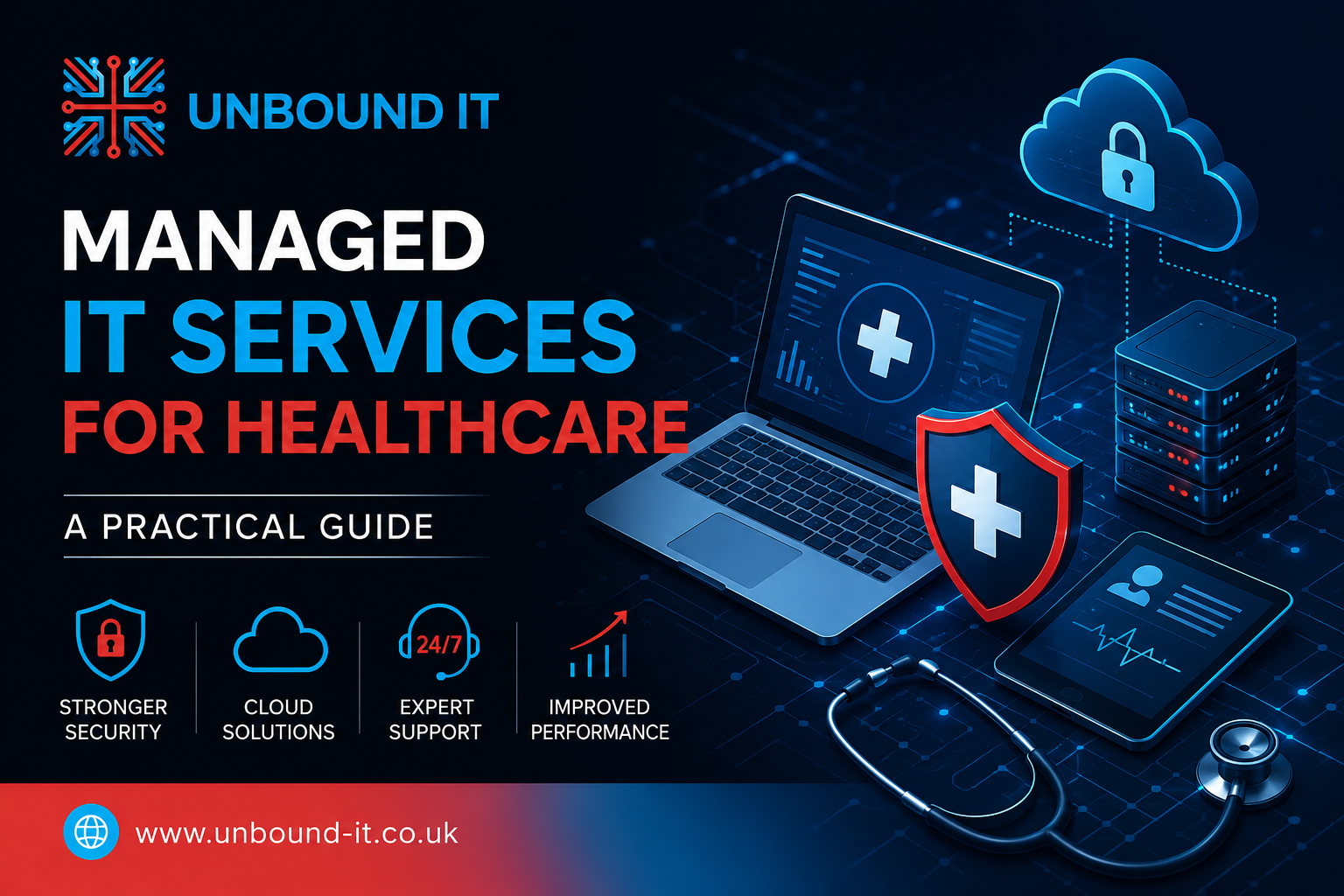

Premium healthcare IT featured image by UNBOUND-IT showcasing managed IT services, cybersecurity, and cloud solutions for UK healthcare providers.
Healthcare organisations depend on technology every day. From booking appointments to storing patient records and supporting remote consultations, reliable IT systems have become an essential part of healthcare. A slow network, a cyber attack, or unexpected downtime can delay treatment, interrupt communication, and affect patient care.
Many healthcare providers do not have the time or resources to manage complex IT systems on their own. This is why more organisations are choosing managed IT services for healthcare. Instead of reacting when problems happen, managed IT providers monitor systems, improve security, reduce downtime, and help healthcare teams focus on patients instead of technology.
At UNBOUND-IT, we provide healthcare IT services that are designed to support clinics, private practices, care homes, dental surgeries, pharmacies, and healthcare organisations across the UK. Our goal is to make technology simple, secure, and reliable so healthcare professionals can deliver the best possible care.
This guide explains everything you need to know about managed IT services for healthcare, including the benefits, key features, common challenges, and how to choose the right IT partner.
What Are Managed IT Services for Healthcare?
Managed IT services for healthcare are professional technology services that handle the day-to-day management of IT infrastructure, networks, devices, cloud systems, cybersecurity, backups, and technical support for healthcare organisations.
Instead of hiring a large internal IT department, healthcare providers work with an experienced managed service provider that continuously monitors and manages their systems.
These services help organisations maintain secure patient records, reduce downtime, improve compliance, and keep healthcare operations running smoothly.
Healthcare IT services usually include:
Network monitoring
Cybersecurity protection
Help desk support
Microsoft 365 management
Backup and disaster recovery
IT consulting
Compliance support
Hardware and software management
Remote and on-site IT support
Why Healthcare Organisations Need Managed IT Services
Healthcare is one of the most targeted industries for cybercrime. Medical records contain sensitive information that criminals want to steal. At the same time, healthcare organisations cannot afford system failures because patient care depends on reliable technology.
Managed IT services help solve these challenges by providing proactive support instead of waiting until something breaks.
Some of the biggest reasons healthcare providers invest in managed IT services include:
Better protection against ransomware attacks
Faster technical support
Reduced downtime
Improved patient experience
Compliance with healthcare regulations
Predictable monthly IT costs
Reliable cloud infrastructure
24/7 monitoring
Business continuity planning
Improved staff productivity
Common IT Challenges in Healthcare
Healthcare organisations often face several technology problems that affect both staff and patients.
Many clinics still use outdated hardware that struggles to run modern software. Some organisations lack proper backup systems, making data recovery difficult after hardware failure. Others experience slow networks that delay patient appointments and communication between departments.
Cybersecurity is another major concern. Healthcare organisations receive phishing emails every day, and one successful attack can expose confidential patient information.
Many providers also struggle with limited IT resources. Internal teams often spend too much time fixing daily technical issues instead of improving long-term infrastructure.
Managed healthcare IT services address all of these challenges through continuous monitoring, maintenance, and expert support.
Managed IT Services vs Traditional IT Support
The biggest difference between managed IT services and traditional IT support is how problems are handled.
| Traditional IT Support | Managed IT Services |
|---|---|
| Fixes issues after they happen | Prevents problems before they happen |
| Mostly reactive | Proactive monitoring |
| Limited business planning | Long-term IT strategy |
| Support during business hours | Often includes 24/7 monitoring |
| Unexpected repair costs | Predictable monthly pricing |
| Limited security management | Continuous cybersecurity protection |
Healthcare providers that rely only on break-fix support often experience more downtime and higher repair costs than organisations using managed IT services.
Key Features of Healthcare IT Services
24/7 Monitoring
Healthcare systems need to remain available around the clock. Continuous monitoring helps identify potential issues before they affect patient care.
Cybersecurity Protection
Healthcare organisations face constant cyber threats. Professional healthcare IT services include endpoint security, firewall management, email protection, antivirus software, threat detection, and regular security updates.
Data Backup and Disaster Recovery
Patient information must always remain accessible. Automated backups and disaster recovery plans ensure healthcare organisations can recover quickly after hardware failure, cyber attacks, or accidental deletion.
Cloud Solutions
Cloud technology allows healthcare professionals to securely access files and applications from different locations while improving collaboration and reducing infrastructure costs.
Help Desk Support
Healthcare staff need fast technical support whenever problems occur. Managed service providers offer remote assistance and on-site support when required.
Microsoft 365 Management
Many healthcare organisations rely on Microsoft 365 for communication and collaboration. Managed IT providers configure, secure, and maintain these services to improve productivity.
Compliance Support
Healthcare organisations must meet strict security and privacy requirements. Managed IT providers help implement policies, security controls, and documentation that support regulatory compliance.
Benefits of Managed IT Services for Healthcare
Better Patient Care
Reliable technology allows doctors, nurses, and administrative staff to spend less time dealing with technical problems and more time helping patients.
Stronger Security
Cybersecurity threats continue to grow every year. Managed IT providers continuously update systems, monitor suspicious activity, and protect healthcare data from attacks.
Reduced Downtime
Every minute of downtime affects appointments, patient communication, and healthcare operations. Proactive maintenance keeps systems running efficiently.
Predictable IT Costs
Unexpected IT repairs can become expensive. Managed IT services usually operate on fixed monthly pricing, making budgeting easier.
Improved Productivity
Healthcare employees work more efficiently when systems perform properly and technical issues are resolved quickly.
Access to IT Experts
Healthcare providers gain access to experienced engineers, cybersecurity specialists, cloud consultants, and IT professionals without hiring a full internal team.
Healthcare IT Services for Different Organisations
Different healthcare organisations have different technology requirements.
| Healthcare Organisation | IT Requirements |
|---|---|
| Private Clinics | Patient record management, appointment systems, cybersecurity |
| Dental Practices | Imaging software support, secure backups, cloud services |
| Care Homes | Staff communication, Wi-Fi management, device security |
| Pharmacies | Secure networks, compliance, system monitoring |
| Medical Centres | Cloud infrastructure, disaster recovery, remote support |
Every organisation requires an IT strategy that matches its size, budget, and operational needs.
Cybersecurity in Healthcare
Cybersecurity is one of the most important parts of managed IT services for healthcare.
Healthcare organisations store confidential patient records, financial information, insurance details, and medical histories. Criminals know this information is valuable.
A strong cybersecurity strategy includes:
Multi-factor authentication
Email security
Employee security awareness training
Firewall management
Endpoint detection
Regular software updates
Network monitoring
Encrypted backups
Access control
Vulnerability assessments
Combining these security measures greatly reduces the risk of cyber attacks.
The Role of Cloud Technology in Healthcare
Cloud computing has changed how healthcare organisations manage information.
Instead of relying only on local servers, providers can securely store data in the cloud while allowing authorised staff to access systems from multiple locations.
Cloud technology offers several advantages.
Healthcare professionals can collaborate more easily.
Remote working becomes secure and efficient.
Files remain protected through automated backups.
Businesses reduce hardware costs.
Systems scale as organisations grow.
Cloud services also improve disaster recovery because important data remains available even if local hardware fails.
Choosing the Right Managed IT Provider
Not every IT provider understands healthcare.
When choosing a managed IT partner, healthcare organisations should consider experience, security expertise, response times, proactive monitoring, cloud knowledge, compliance support, and customer service.
A good provider becomes a long-term technology partner instead of simply fixing occasional technical issues.
Healthcare organisations should also look for providers that offer flexible solutions as their business grows.
Why Choose UNBOUND-IT?
UNBOUND-IT delivers reliable managed IT services for healthcare across the UK. We understand that healthcare providers need secure, stable, and responsive technology to support patient care.
Our healthcare IT services are designed to reduce downtime, strengthen cybersecurity, improve productivity, and simplify IT management.
Our services include:
Managed IT Services
Microsoft 365 Support
Backup and Disaster Recovery
Network Management
Remote IT Support
On-site Technical Support
Whether you operate a private clinic, dental practice, care home, pharmacy, or healthcare organisation, our experienced team provides tailored technology solutions that support your business goals.
Instead of reacting to problems, we continuously monitor your systems and work to prevent issues before they affect your staff or patients.
Future Trends in Healthcare IT
Healthcare technology continues to evolve rapidly.
Artificial intelligence is helping healthcare professionals analyse medical information more efficiently. Cloud adoption continues to increase as organisations modernise their infrastructure. Cybersecurity investments remain a top priority because threats continue to become more advanced.
Remote healthcare services are also expanding, increasing the demand for secure digital communication platforms.
Managed IT providers help healthcare organisations adapt to these changes while maintaining secure and reliable technology.
Conclusion
Technology has become one of the most important foundations of modern healthcare. Reliable systems improve patient care, strengthen data security, increase productivity, and support long-term business growth.
Managed IT services for healthcare help organisations move away from reactive IT support and adopt a proactive approach that prevents problems before they occur. From cybersecurity and cloud solutions to disaster recovery and day-to-day technical support, healthcare providers benefit from expert guidance and continuous monitoring.
If your healthcare organisation wants secure, dependable, and scalable technology solutions, UNBOUND-IT is ready to help. Our experienced team delivers managed IT services, healthcare IT services, cloud solutions, cybersecurity, and ongoing technical support tailored to the needs of healthcare providers across the UK. By partnering with UNBOUND-IT, you can focus on delivering excellent patient care while we take care of your technology.
Frequently Asked Questions.
1. What are managed IT services for healthcare?
Managed IT services for healthcare provide proactive IT support, cybersecurity, cloud management, and network monitoring to help healthcare organisations maintain secure and reliable technology.
2. Why are healthcare IT services important?
Healthcare IT services improve data security, reduce downtime, ensure compliance, and help healthcare providers deliver better patient care through reliable technology.
3. How do managed IT services improve cybersecurity in healthcare?
Managed IT providers protect healthcare organisations with 24/7 monitoring, firewall management, endpoint security, data backups, and threat detection to reduce cyber risks.
4. Can managed IT services help healthcare organisations reduce IT costs?
Yes. Managed IT services offer predictable monthly pricing, reduce unexpected repair costs, and minimise downtime, making IT expenses easier to manage.
5. Why choose UNBOUND-IT for healthcare IT services?
UNBOUND-IT provides secure managed IT services for healthcare, including cloud solutions, cybersecurity, IT support, and proactive monitoring tailored to UK healthcare providers.